
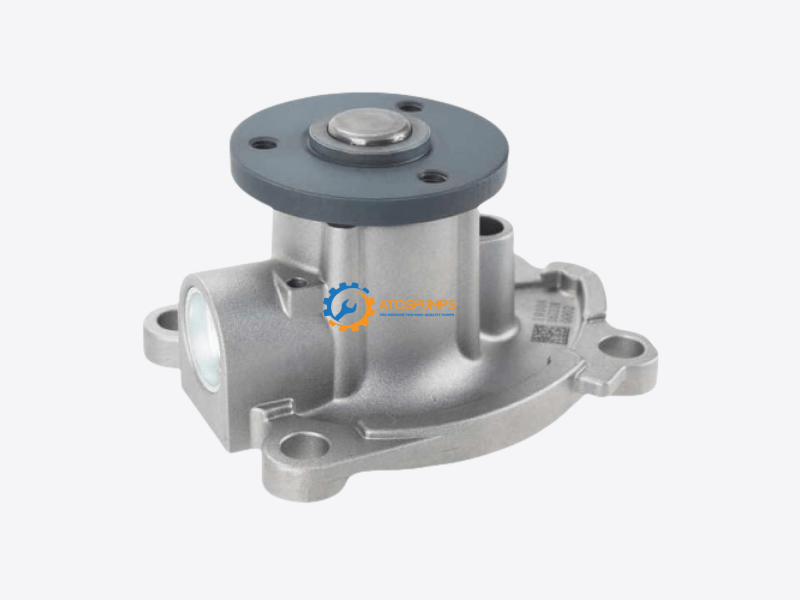

Truck water pumps are deceptively simple machines. A housing, an impeller, a shaft, a bearing, a seal — and yet for a heavy-duty diesel engine, this spinning assembly can mean the difference between a million-kilometer journey and a catastrophic thermal seizure. Across the commercial-vehicle spectrum — DAF, Detroit, DEUTZ, Nissan, Mitsubishi, Isuzu, Hyundai, Iveco, MAN, Scania, Renault, Volvo — the water pump is engineered with deliberate, brand-specific precision. A replacement pump that is even fractionally off specification will not simply wear out; it will drag the engine down with it.
This blog doesn’t wander into radiator chemistry or EGR cooler diagnostics. It talks about the pump: the metal, the impeller, the bearing, the seal, and the critical minutes of installation. Below are five essential, pump-only truths that every fleet operator, independent technician, and owner-driver must understand to keep their truck’s coolant moving reliably.
1. Pump Material Choices Are a Brand Philosophy — Match the Metallurgy
A water pump’s housing and impeller material are never arbitrary. European manufacturers (Volvo, Scania, MAN, DAF, Renault, Iveco) and Japanese/Korean builders (Isuzu, Mitsubishi Fuso, Nissan Diesel, Hyundai) follow fundamentally different design philosophies that directly impact what you should buy for replacement.
European heavyweights have converged on lightweight, high-strength engineering composites for impellers, or tightly machined cast-iron units with exceptionally close housing clearances. A Volvo D13 water pump, for example, uses a composite impeller that weighs a fraction of its cast-iron equivalent, reducing rotational inertia and bearing load. The material is dimensionally stable across temperature swings and resistant to the organic-acid-technology coolants mandated by Volvo. Pair that pump with a high-silicate Asian green coolant, and the impeller’s surface can suffer erosion pitting. Likewise, a Scania DC13 water pump’s cast-iron impeller runs with a volute clearance of around 0.5 mm — a figure that aftermarket “will-fit” pumps often widen to 1.2 mm or more to simplify manufacturing. The result is not an immediate overheat; it’s a silent 15-20% flow reduction that gradually starves the rearmost cylinder of cooling, cracking the head at 300,000 km.
In contrast, Japanese and Korean brands (Isuzu 6HK1, Mitsubishi 6M60, Hyundai heavy-duty engines) still lean heavily on robust cast-iron impellers with slightly wider clearances by design. These pumps are built to handle a broader variation in coolant quality and a bit of silt without seizing. The bronze thrust washer inside a Nissan Diesel MD92 water pump is a feature Scandinavian designs rarely need. But if you install an aftermarket pump with a cheap sintered thrust ring instead of solid bronze, the ring will disintegrate within 50,000 km, sending copper flakes into the bearing and causing shaft wobble. For DEUTZ engines (TCD 2013/2015 series), the water pump housing is often a structural part of the front timing cover; a pump made from an inferior aluminum alloy will creep under thermal cycling, loosening bolt torque and inviting a gasket blowout. The takeaway is ruthless: order your replacement pump by the engine serial number, not the generic catalog listing. A DAF MX-13 pump from the Paccar parts system is metallurgically distinct from an aftermarket “equivalent” in ways that only a dynamometer coolant-flow test will reveal.
2. Impeller Clearance and Cavitation: The Pump’s Internal Erosion Is a Warning
Cavitation is not a liner problem; it begins inside the pump. The water pump impeller spins fast enough to create extreme low-pressure zones on its vane surfaces. If the inlet flow is restricted or the pump speed exceeds design limits, vapor bubbles form and collapse with hammer-like force, chewing pits out of the impeller metal.
Every pump removed from a truck tells a cavitation story. In a DEUTZ 1013 water pump, a “scalloped” erosion pattern on the leading edge of the impeller vanes points to air being pulled past a partially clogged radiator fin stack or a suction hose that collapses under vacuum. For a MAN D20/D26 pump, a band of pitting on the back of the impeller disc — the side facing the bearing — reveals that the pump has been operating with a coolant concentration exceeding 60% glycol. The thick, viscous mixture amplifies cavitation implosion energy. On a Scania DC09/13 pump, impeller vanes that appear sandblasted on the pressure face but untouched on the suction face indicate a chronic over-speed condition, often caused by a smaller-diameter pulley fitted during an aftermarket fan-drive upgrade that nobody thought to re-calculate.
Cavitation damage to the pump housing itself is just as diagnostic. An IVECO Cursor 10 water pump housing that shows a polished, wavy erosion pattern on the cutwater (the point where the volute channel splits) is broadcasting that the engine has spent too many hours at peak torque with the thermostat barely cracked open, forcing the pump to churn against a near-dead-headed system. Swapping in a new pump without addressing the system restriction is wasted money; the same erosion will return. Before you toss the old pump, photograph the impeller and housing interior. Those scars are a free failure-analysis report, and the corrective action — whether it’s a coolant ratio adjustment, a new radiator, or a standard-diameter pulley — will save the next pump from the same fate.
3. Bearing Failure Speaks in a Language You Must Learn
Modern truck water pumps use a sealed, double-row angular-contact ball bearing cartridge that is lubricated for life. That life is finite, and the way the bearing dies is predictable enough to allow proactive replacement — if you listen.
Belt-driven pumps, typical on MAN, Volvo FH, Renault Magnum, Mitsubishi Fuso, and Hyundai Xcient, transmit belt load directly to the bearing. The first warning is a low, rhythmic growl at idle that can easily be mistaken for an alternator or idler bearing. The key differentiator: a water-pump bearing with spalled raceways will change its pitch when you momentarily load the cooling fan clutch. At operating temperature, the noise may almost vanish because thermal expansion has tightened the internal clearances. A mechanic who spins the pulley by hand with the belt removed and feels a regular “click-click” or gritty sensation has caught the bearing in the second stage of failure, where hardened steel flakes are grinding between the races. Replace the pump immediately. If you postpone, the next phase is a complete cage fracture, which on a Renault DXi 11 allows the shaft to walk forward, munching the impeller into the housing and sending shrapnel through the timing case.
Gear-driven pumps — found on DAF MX engines, Detroit Diesel DD13/DD15, and certain DEUTZ applications — eliminate belt side-load but introduce a different failure signature. Because the pump shaft spins at a fixed ratio to the camshaft, a failing bearing produces a precise, cyclic chirp synchronized to half engine speed. On a Detroit DD15, this chirp is often misdiagnosed as a valvetrain issue. A stethoscope placed directly on the water pump mounting boss on the front gear housing isolates the sound. The real danger of a gear-driven pump’s bearing collapse is internal oil contamination: DAF MX-13 water pump weep holes drain into the crankcase, and bearing debris can enter the engine oil. If you catch a gritty bearing before the shaft seal fails, a simple pump swap is all you need. Miss it, and you’re flushing bearing particles out of every oil gallery in the block.
4. The Weep Hole Is an Engineered Sensor, Not a Leak
The tell-tale hole between the pump’s mechanical seal and the bearing housing is the most abused diagnostic port on any truck engine. It exists to protect the bearing from coolant migration, and its output reveals the exact health of the water-pump seal.
A healthy seal will, over thousands of hours, leave a faint, dry, white or blue-gray stain around the weep hole. That’s the harmless residue of the coolant additive package crystallizing as the microscopic vapor film that lubricates the seal faces escapes. This is normal on Volvo, Scania, and Isuzu pumps. What is not normal is a clear, sticky droplet of liquid coolant: this signals that the seal faces are being chemically attacked. Silicate dropout is the primary culprit. Generic green coolants overloaded with silicates will precipitate hard particles that wedge between the carbon and silicon carbide faces of the pump seal, gouging microscopic wakes. On a Mitsubishi 6M60 water pump, you’ll see a glossy black ring worn into the ceramic face — the carbon has been ground into a paste. The pump is emitting a chemical distress signal, not a mechanical failure. Flushing the cooling system and refilling with the correct low-silicate OAT coolant before installing the new pump is the only lasting fix.
A weep hole weeping a rusty, orange-brown emulsion after long shutdowns points to seal face corrosion from standing water inside the pump — a problem for trucks that sit for weeks between jobs (many Nissan Diesel and Hyundai construction vehicles suffer this). The iron seal seat oxidizes, pitting the surface, and the next start-up tears the carbon ring. The pump was never defective; the engine’s coolant lacked adequate corrosion inhibitors during storage. If you ever spot a thick, gooey black residue from the weep hole, the pump seal has been overwhelmed by carbon particulate from the system; the seal lips have failed from abrasion, not age. In every case, a new pump without understanding the weep-hole message is a pump that will weep again. Read the hole, correct the chemistry, then mount the replacement.
5. Installation Is the Final Quality Check — Torque, Alignment, and the Dry-Spin Ritual
A water pump fresh from the box can be destroyed within its first 30 seconds of engine run. The margin between a lifetime of service and infant mortality lies entirely in the installer’s hands.
Water pump housings, particularly cast-aluminum ones on DAF, Scania, and Iveco engines, warp under uneven bolt torque. The correct sequence is always a two-stage, star-pattern tightening, with the first stage usually half the final torque. DAF MX water pump bolts (M8) call for 8 Nm initial torque followed by a 90-degree angle-tightening. Chasing the bolts in a circle will warp the housing flange by 0.05 mm — enough to pinch the impeller against the housing on a hot soak and snap the shaft. Always use a calibrated torque wrench, never an impact gun, and replace any bolt that shows thread stretching. For Volvo D13 and MAN D26 pumps, the pulley bolts demand the same respect: old thread-locker residue in the crank pulley holes can cause false torque, leaving the pulley to wobble at 2,200 rpm and hammer the new pump’s bearing race into false-brinelling failure within a month.
Belt alignment is the next silent killer. A poly-V belt that runs 0.5 degrees out of parallel between the crank, tensioner, and water pump pulleys exerts a constant axial thrust on the water pump shaft. On a Scania V8 water pump, that thrust overloads the bearing’s ball complement and can reduce calculated bearing life by 80%. A laser alignment tool costs a fraction of a premature engine teardown.
Finally, the “dry spin” is the ritual that separates experienced mechanics from parts-changers. A freshly installed pump’s seal faces are utterly dry. If the engine is started immediately after coolant fill, the impeller spins in a vapor pocket for three to five seconds before liquid coolant reaches it. That’s enough dry-spinning time to fracture the carbon seal face, guaranteeing a weep at 60,000 km. The correct procedure: fill the system, rotate the water pump pulley by hand (belt off) at least three full revolutions to flood the impeller chamber with coolant, then pressurize the surge tank to 0.5 bar before releasing the starter. This sequence primes the seal and purges trapped air. On an IVECO Stralis pump, skipping the hand-prime often leads to a persistent, rhythmic chirp from the seal that never quiets.
Truck water pumps are precision tribological assemblies, not commodity castings. Whether you’re wrenching on a DAF XF, a Detroit DD15, a DEUTZ 1013, a Nissan UD, a Mitsubishi Super Great, an Isuzu Giga, a Hyundai HD, an Iveco Trakker, a MAN TGX, a Scania R, a Renault T, or a Volvo FH, the pump you install is a decision with a million-kilometer consequence. Select by metallurgy and original clearance, read the cavitation scars, listen to the bearing, interpret the weep hole, and never shortcut the installation ritual. Do these five things, and the water pump will remain the quiet, reliable heart it was designed to be.