
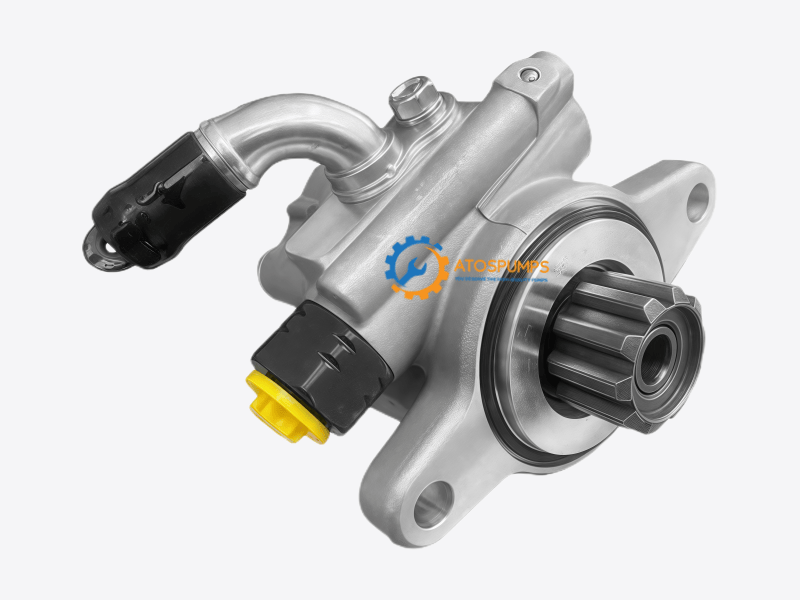

A power steering pump does far more than make turning effortless. It stabilizes directional control during emergency manoeuvres, dampens road shock, and directly influences driver fatigue and safety. When a pump fails—be it on a BMW 3 Series, an ISUZU truck hauling freight, a FORD tractor ploughing a field, or a MERCEDES BENZ van making deliveries—the result is not just a stiff wheel. Hardened seals disintegrate, sending debris through the rack, while fluid starvation scores bearings and destroys the steering system. Sourcing a pump that endures requires looking beyond generic catalogues. Here are four original, in-depth tips to identify a genuinely high-quality power steering pump and why connecting with a knowledgeable supplier saves time, money, and risk.
1. Match Exact Original Hydraulic Specifications—Not Just the Bolt Pattern
A pump may bolt to the engine perfectly yet deliver entirely incorrect hydraulic characteristics. Every manufacturer specifies a precise combination of maximum pressure, flow rate at idle and elevated RPM, relief valve cracking point, and displacement per revolution. A CHEVROLET Silverado demands a high-flow pump to handle large tyres and a heavy front axle, while a DAEWOO compact car uses a lower-displacement unit with a specific outlet fitting. A TOYOTA Land Cruiser must sustain constant pressure during low-speed crawling, something an economy replacement cannot replicate. For commercial vehicles, demands are more unforgiving. A DAF LF or SCANIA P-series relies on a pump with an integrated reservoir and often a dual-circuit pressure line. VOLVO trucks frequently use variable displacement control that adjusts output based on steering demand; installing a fixed-displacement pump overheats the fluid within hours. Even tractors like a MASSEY FERGUSON 5400 series require a pump whose shaft seal and body cope with constant dust and vibration. A quality pump matches not only the mounting flange and pulley offset but the entire hydraulic map of the original. Provide your VIN or original part number to a supplier who cross-references factory engineering data, not just aftermarket catalogues. That extra step separates a pump that “fits” from one that actually works for the life of the vehicle.
2. Demand Internal Component Quality That Survives Heat and Hard Work
The difference between a pump that lasts a season and one that endures a decade lies in the materials chosen for vanes, seals, bearings, and pressure plates. Inside a quality HONDA or MAZDA power steering pump, the rotor vanes are often carbon-reinforced polyamide or specially coated alloy steel that slides smoothly without gouging the cam ring, even during cold starts with thick fluid. Cheap pumps may substitute uncoated steel vanes that rapidly score the cam ring, producing a whining noise and shedding metal particles that block steering rack filters on a LAND ROVER Discovery or a PEUGEOT 508. The shaft lip seal is another battleground. A premium pump for a HINO truck or a FOTON commercial vehicle uses a fluoroelastomer (FKM) seal that resists hardening at sustained temperatures exceeding 120°C. Generic NBR seals harden and crack, causing fluid leaks that starve the pump and strand a driver. Bearings matter too. A MITSUBISHI Fuso or ISUZU NPR with a heavy front axle needs a robust roller bearing supporting the input shaft, not a simple sintered bushing that develops play under continuous belt tension. When evaluating a pump for a RENAULT tractor or HYUNDAI excavator loader, check if the pressure relief valve is a screw-in cartridge type that can be cleaned or replaced, or a non-serviceable pressed-in plug that turns the pump into a throwaway item. A quality manufacturer openly specifies seal material, bearing type, and vane technology because those details speak directly to durability. If a seller cannot answer these internal material questions, the pump is built to a price, not a standard.
3. Prioritize Tested, Real-World Hydraulic Performance and Low Noise
A power steering pump should be silent and transparent. Any growl, whine, or vibration under load signals cavitation, internal leakage, or poor machining tolerances that quickly worsen. Genuine quality pumps are individually tested on hydraulic benches simulating vehicle conditions: cold start, full-lock stall, rapid steering inputs, and extended cruising. A reputable supplier of pumps for BMW, NISSAN, and RENAULT cars verifies that the pump maintains stable pressure without oscillation across the full RPM range and that flow rate stays within the OEM envelope even when oil temperature rises. This eliminates pumps with casting porosity or burrs inside the flow control valve that cause erratic steering effort. For heavy-duty applications, noise is an early failure warning. A BOSCH pump fitted to a MERCEDES BENZ Actros or SCANIA G-series should produce only a faint hiss; any metallic grating suggests misaligned gears or a damaged cam ring. On a FORD 5600 tractor, a noisy pump often results from air ingestion via a poorly machined suction port, leading to aerated fluid and sudden loss of assist on an incline. Ask if pumps are bench-tested and whether a test report is provided. A pump that leaves the factory without a hydraulic signature is a gamble, not a guarantee.
4. Insist on Comprehensive Warranty, Technical Support, and System Guidance
A warranty certificate is only as good as the expertise behind it. Look for a supplier who asks about your vehicle’s specific model, year, and even the fluid you intend to use, because a high-quality pump for a modern PEUGEOT or TOYOTA may require a specific synthetic fluid incompatible with generic ATF. They should also provide detailed installation instructions: torque values for mounting bolts, the correct bleeding procedure, and a recommendation to flush the entire steering system before installation. Contaminated fluid is the primary killer of replacement pumps. In a CHEVROLET Express van or an ISUZU D-Max pick-up, residue from a failed pump can lodge in the steering gear and destroy the new pump within weeks. A dedicated supplier supplies not only the pump but also advice on flushing equipment and the correct fluid specification for your LAND ROVER, HINO, or FORD tractor. Warranty terms matter. A quality pump for a commercial vehicle, such as a DAF or VOLVO truck, should come with a minimum twelve-month, unlimited-mileage warranty that includes straightforward replacement should a manufacturing defect surface. Beyond paperwork, there should be a real technical contact who can assist if a FOTON or HYUNDAI pump installation runs into a challenge. This level of support turns a transaction into a partnership and ensures the pump becomes a lasting solution rather than a recurring headache.
When you source a power steering pump that meets exact OEM hydraulic specs, features premium internal materials, has been validated on a test bench, and is backed by genuine engineering support, you protect every other component in the steering system. Whether you maintain a fleet of NISSAN trucks, restore a MASSEY FERGUSON tractor, or want absolute reliability from your daily-driven BMW or HONDA, the right pump is out there—but it takes an informed eye to find it. If you’re looking for a power steering pump that truly measures up to these rigorous standards, we invite you to send us your inquiry. With extensive cross-reference data, bench-tested units, and a commitment to supporting every vehicle from a DAEWOO passenger car to a SCANIA heavy truck, our team is ready to help you identify the exact quality pump your machine deserves.